Working out Crown Court advocate fees can be difficult when a case includes different hearings, offence categories, trial days, preparation work, or additional fees. A simple mistake in the case information can lead to an incorrect estimate.
This is where an AGFS Calculator can be useful.
The Advocates’ Graduated Fee Scheme (AGFS) provides the framework for remunerating advocates who undertake legally aided Crown Court work. The Legal Aid Agency provides calculators to help practitioners work out fees under the scheme.
But how does the calculator actually arrive at a figure?
The answer depends on the details entered into it. The calculator uses information about the case and the applicable AGFS rules to help produce an estimated fee. Understanding those inputs makes it much easier to check whether the result looks reasonable.
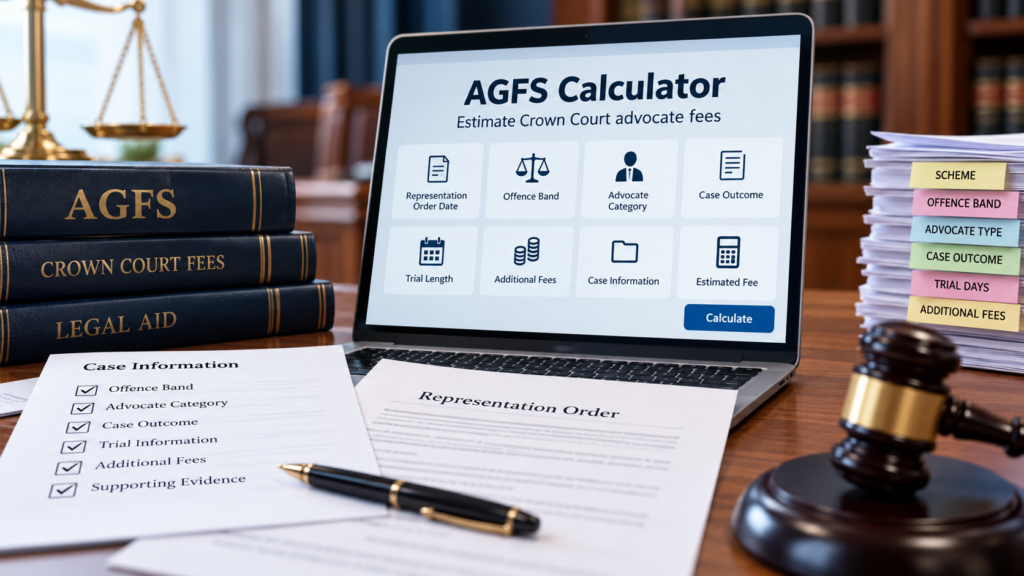
AGFS Calculator: What Does It Actually Do?
An AGFS Calculator is essentially a fee-estimation tool.
It helps advocates and legal teams apply the relevant graduated fee structure to a Crown Court case. Rather than manually working through every applicable fee provision, the calculator provides a structured way to enter case information and obtain an estimate.
The Legal Aid Agency provides calculator information for different AGFS scheme periods. The GOV.UK calculator page was last updated on 19 May 2026 and still lists Scheme 13 and earlier downloadable calculators, while the current AGFS fee data now identifies Scheme 17, starting on 28 July 2026.
That point is important.
Using a calculator that does not correspond to the relevant scheme can produce the wrong result.
The First Question: Which AGFS Scheme Applies?
Before entering figures, identify the applicable scheme.
This is one of the most important checks because AGFS has been amended over time.
As of 27 October 2026, the current AGFS fee data identifies Scheme 17 as having started on 28 July 2026.
Start by checking the representation order.
The date of the representation order can determine which version of the fee guidance and calculator should be used.
A billing team should therefore avoid simply opening an old spreadsheet saved on a computer and assuming that it remains appropriate.
Instead:
- Check the representation order date.
- Identify the applicable AGFS scheme.
- Check the current LAA guidance.
- Use the calculator or fee information associated with that scheme.
- Keep the calculation with the case records.
This simple check can prevent a much larger billing problem later.
What Information Goes Into the Calculation?
An AGFS calculation is based on case information rather than one universal rate.
Depending on the type of claim, relevant information may include the offence category or band, advocate category, case outcome, trial information and other applicable fee elements.
The current AGFS fee data contains different scenarios, advocate types, offence classes and fee types, showing why the details entered into a calculation matter.
The information should come from the actual case records.
Do not rely on memory when entering important details.
Offence Banding Matters
The offence band is an important part of the AGFS calculation.
Different offences can fall into different bands, and the relevant band affects the fee calculation.
This means that two Crown Court cases can involve a similar amount of advocacy but produce different fee estimates because their offence classifications are different.
Before relying on the calculator result, check that the offence has been classified correctly.
If the offence does not appear to fit the expected category, investigate the applicable guidance rather than choosing an option simply because it produces a preferred amount.
The Advocate Category Can Change the Result
The advocate category is another important factor.
The current AGFS fee data includes categories such as Junior, Leading Junior and KC, with different fee values depending on the relevant scenario and offence class.
For this reason, the person completing the calculation should make sure the correct advocate information is used.
An incorrect selection here can affect the calculation even when every other case detail has been entered correctly.
Guilty Plea, Cracked Trial or Trial?
The outcome or type of Crown Court proceeding can also affect the calculation.
The AGFS framework includes different treatment for matters such as guilty pleas, cracked trials and trials.
That is why a legal team should not assume that every Crown Court case follows the same calculation.
A case that ends with a guilty plea may be treated differently from one that proceeds to a full trial.
Likewise, a cracked trial can have its own fee treatment.
The calculator needs the correct case outcome so that the relevant calculation can be applied.
How Trial Length Can Affect the Calculation
For a trial, the fee structure can include a basic fee and daily attendance fees for additional trial days, depending on the applicable scheme and circumstances.
This is one reason accurate court attendance records matter.
If the trial length entered into the calculation does not match the court record, the resulting estimate may not reflect the actual claim.
Before completing the calculation, check the relevant court records and attendance information.
A Practical Example
Imagine an advocate is dealing with a legally aided Crown Court case that proceeds to trial.
The billing team first identifies:
- The representation order date.
- The applicable AGFS scheme.
- The offence band.
- The advocate category.
- The type of case outcome.
- The relevant trial attendance information.
Those details are then entered into the appropriate calculator or current fee data.
The calculator produces an estimated fee based on the applicable scheme.
The team can then compare that figure with its own case records before preparing the final claim.
The important point is that the calculator is doing the calculation from the information supplied. If the information is wrong, the estimate can also be wrong.
What About Preparation Work?
Preparation is an important part of advocacy work, but not every piece of preparation should simply be added to the calculator as an hourly amount.
The AGFS system uses graduated fees designed to cover defined areas of work. There can also be circumstances where additional preparation or special preparation fees apply.
The rules for these additional elements should be checked separately rather than assuming they are automatically included in the standard calculation.
This distinction is important because adding unsupported amounts to an estimate can create an unrealistic expectation about the eventual payment.
Additional Fees Need Separate Attention
Not every payment associated with an AGFS case is necessarily captured by simply looking at the basic graduated fee.
For current 2026 claims, the additional preparation fee is particularly important. The Legal Aid Agency confirmed that the fixed fee increased from £62 to £81 for relevant representation orders dated on or after 28 July 2026. The change also extended the additional preparation fee to eligible guilty plea cases.
The LAA also issued guidance explaining how the additional preparation fee should be claimed through the Claim for Crown Court Defense billing tool.
This illustrates why practitioners should check current guidance rather than relying entirely on an old calculation spreadsheet.
Why Calculator Versions Matter
One of the easiest mistakes is using the wrong calculator.
The LAA’s public calculator page contains calculators for different periods and schemes, while current AGFS fee data now reflects Scheme 17 from 28 July 2026.
A spreadsheet that worked for an older representation order may not be suitable for a newer case.
Before starting:
Check the representation order date.
Identify the relevant scheme.
Open the corresponding calculator or current fee data.
Read any associated instructions.
Then complete the calculation.
This takes little time but can prevent unnecessary corrections.
What If the Calculator Result Looks Too High or Too Low?
Do not immediately change the figures until the result looks more familiar.
Instead, work backwards.
Check the information entered into each field.
Look particularly at:
- Representation order date
- Offence classification
- Offence band
- Advocate category
- Case outcome
- Trial length
- Additional fee selections
- Any other case-specific information
Compare the entries with the case file.
If everything appears correct but the result still seems unusual, consult the relevant Crown Court Fee Guidance before submitting the claim.
Calculator Estimate vs Actual Payment
An important distinction should always be kept in mind.
An AGFS Calculator provides a calculation based on the information entered. It does not guarantee that the LAA will pay exactly that amount.
Claims are submitted through the Crown Court Defense billing system, and the LAA has a process for assessing claims.
The final payment can therefore depend on whether the claim satisfies the applicable rules and whether the supporting information is sufficient.
The calculator is best used as a planning and checking tool.
Common AGFS Calculator Mistakes
Using an Old Calculator
An old spreadsheet may relate to a different AGFS scheme.
Always check the applicable representation order date.
Choosing the Wrong Offence Band
The offence classification can have a significant effect on the calculation.
Check the official guidance rather than making an assumption.
Entering the Wrong Advocate Category
The calculator should reflect the correct advocate category for the claim.
Ignoring the Case Outcome
A guilty plea, cracked trial and trial can have different fee treatment.
Forgetting Additional Fee Rules
Current 2026 additional preparation rules should be considered where applicable.
Treating the Result as the Final Payment
A calculator result is an estimate based on the information entered. It is not the same thing as an assessed payment.
A Better Way to Check an AGFS Calculation
A short internal review can make calculations much more reliable.
Before submitting the claim, ask:
1. Is the correct AGFS scheme being used?
2. Does the representation order date match the applicable scheme?
3. Is the offence band correct?
4. Is the advocate category correct?
5. Is the case outcome recorded correctly?
6. Does the trial information match the court record?
7. Have current additional fee provisions been considered?
8. Does the calculated amount make sense against the case records?
If something does not match, investigate it before submitting the claim.
Keep the Calculation With the Billing Records
A saved calculation can be useful when a claim is reviewed later.
For a well-organized file, consider keeping:
- Case reference
- Representation order date
- Calculator or fee-data version
- Date the calculation was completed
- Information used
- Estimated amount
- Any additional fee considerations
- Notes explaining unusual circumstances
This creates a clear record of how the estimate was produced.
It can also help another member of the billing team understand the calculation without starting from the beginning.
How the Calculator Fits Into Online AGFS Claims
The calculator is only one stage of the wider billing process.
Once the estimated fee has been checked, the advocate or billing team still needs to prepare and submit the claim through the appropriate system.
The LAA’s 2026 guidance explains that the additional preparation fee is claimed through the relevant Claim for Crown Court Defense billing tool.
A sensible workflow is therefore:
Case records → identify scheme → calculate fee → review calculation → prepare claim → attach relevant evidence → submit → monitor the outcome
This keeps the calculation separate from the submission itself while allowing the estimated amount to act as an important checking point.
Final Thoughts
Understanding how an AGFS Calculator works makes Crown Court fee preparation much easier.
The calculation starts with accurate case information. The relevant AGFS scheme must be identified, the offence band and advocate category checked, and the case outcome and trial information entered correctly.
The result should then be reviewed rather than accepted automatically.
As of 27 October 2026, practitioners should also take account of the AGFS changes introduced from 28 July 2026, including the increase in the additional preparation fee from £62 to £81 and its extension to eligible guilty plea cases.
Current AGFS fee data identifies Scheme 17 as starting on 28 July 2026 and continuing to the present.
A calculator cannot replace careful billing practice, but it can make fee estimation faster, clearer and easier to check before an AGFS claim is submitted.