Crown Court billing: what has changed this year? is a question more firms are asking — and urgently. Billing rules, fee rates, and administrative requirements have all shifted, and the gap between what firms claim and what they are paid is widening for those still working from old processes.
The risks are real: delayed payments, queried or rejected claims, and cash flow pressure that builds quietly until it becomes a serious problem. Getting billing right in this environment isn’t just about accuracy — it’s about understanding what the current rules actually require.
This article covers what has changed in Crown Court billing this year, where firms are still losing money through avoidable errors, and what practical steps billing staff and practice managers can take right now to tighten up their process and protect their revenue.
Crown Court Billing: What Has Changed This Year?
Crown Court billing has changed in three main areas this year: fee rates, administrative requirements, and submission expectations. Each of these changes has a direct effect on how claims are prepared and whether they are paid promptly.
Fee structures have been updated across fixed and graduated fee schemes, and firms that haven’t reviewed their internal rate guides are likely working from outdated figures. At the same time, the checks applied before a claim is processed have become more thorough, with more attention on correct coding, complete documentation, and clean case records.
Firms that review their billing process now — before errors accumulate — are in a much stronger position. Those that carry on as before will find more claims coming back with queries, more time spent on follow-up, and more delays between the work being done and the money arriving. The sections below go into more detail on each of the three main changes.

Key Changes to Fee Structures and Calculation Rules
One of the most significant areas of change in 2026 concerns how fees are calculated for certain Crown Court case types. The graduated fee scheme — which determines payment based on offence category, pages of prosecution evidence, and trial length — has seen adjustments to both the rate tables and the criteria for classifying cases into specific categories.
Updated Offence Categories and Rate Tables
The offence categories used to calculate graduated fees have been reviewed, with some reclassifications affecting the fee bracket that applies to certain types of cases. Firms that have been relying on category selections from previous years without checking the current guidance may find that their claims are being assessed under a different category — sometimes resulting in a lower payment than expected.
Billing staff should cross-check every active Crown Court matter against the current 2026 rate tables before submission. A category that was correct in 2024 may no longer reflect the right classification under updated LAA guidance.
Changes to Pages of Prosecution Evidence Counting
The rules around how pages of prosecution evidence are counted — a key driver of the graduated fee calculation — have been clarified further in 2026. Specifically, guidance on which materials count toward the PPE total and which are excluded has been tightened, reducing ambiguity but also closing off some interpretations that firms had previously relied on.
Firms should confirm their PPE counting method against the current LAA billing guidance to ensure they are neither underclaiming nor submitting counts that differ from what the LAA will accept.
What Has Changed in the Evidence and Documentation Requirements
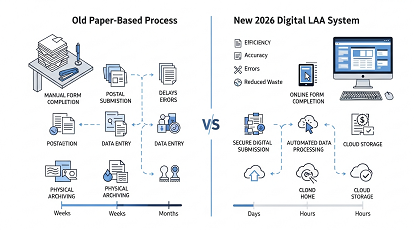
The shift from paper-based to digital Crown Court billing is accelerating in 2026 — firms still using manual processes face greater risk of error and delay under tightened documentation rules.
Supporting evidence requirements for Crown Court claims have become more specific this year. The LAA has increased its focus on ensuring that every item claimed is properly evidenced — particularly for disbursements, expert fees, and preparation time claimed in complex cases.
Stricter Disbursement Evidence Standards
In previous years, some disbursements were accepted with minimal supporting documentation. In 2026, the expectation is that every disbursement — expert witness fees, interpreter costs, transcript charges, and travel expenses — is accompanied by a signed invoice or receipt that clearly shows the amount, the service provided, and the date. Claims submitted without this level of documentation are more likely to be queried or reduced.
Firms should audit their current file management approach to ensure that disbursement invoices are being collected, saved, and linked to the relevant claim at the point the expense is incurred — not reconstructed at the billing stage.
Attendance Notes and Preparation Time
Preparation time has always been a scrutinized element of Crown Court claims, but in 2026 the LAA’s expectations around contemporaneous attendance notes have become clearer. Notes that are vague, undated, or appear to have been written retrospectively are more likely to be challenged. The expectation is that notes are written at or immediately after the relevant meeting, call, or task — and that they describe the work in enough detail to justify the time recorded.
How the Submission Process Has Evolved

Legal teams that meet regularly to review billing process changes stay ahead of LAA updates and avoid the costly errors that come from outdated procedures.
The mechanics of how Crown Court claims are submitted have continued to shift toward digital-first processes in 2026. Firms still submitting paper claims or using outdated portal versions are encountering more friction than those operating within the current digital submission framework.
Portal and System Updates
The LAA’s digital submission system has been updated in 2026, with interface changes that affect how certain claim types are entered and submitted. Billing staff who have not been trained on the updated system may be navigating outdated workflows that no longer reflect the current portal structure — leading to errors at the submission stage that are entirely avoidable.
Investing a small amount of time in familiarising the billing team with the current portal version is one of the simplest ways to reduce submission errors this year.
Tighter Submission Deadlines
Deadline enforcement for Crown Court claims has become more consistent in 2026. Late submissions — even by a short margin — are being treated with less flexibility than in previous years. Firms that have relied on informal extensions or tolerance around deadlines should now treat submission dates as firm boundaries.
Building a reminder and review system that prompts billing action well before the submission deadline is a straightforward operational change that protects income.
What Legal Teams Should Review and Update Now
Given the changes described above, there are several practical steps every Crown Court billing team should take to make sure their process is current and compliant in 2026:
- Review the current LAA rate tables and confirm that offence categories are being selected correctly for active and pending claims
- Update your PPE counting method against the 2026 guidance to ensure it matches the LAA’s current expectations
- Strengthen disbursement evidence collection — put a process in place to capture invoices at the point of expense, not at the billing stage
- Audit your attendance notes — check that notes are contemporaneous, specific, and sufficient to support the preparation time being claimed
- Train billing staff on the current LAA portal — make sure everyone using the system is familiar with the 2026 interface and entry requirements
- Treat all deadlines as firm — remove any assumption that late submissions will be accepted and build earlier review steps into the claim preparation timeline
Conclusion
Crown Court billing in 2026 is operating under a tighter, more defined set of rules than in previous years. Fee categories, evidence standards, documentation requirements, and submission expectations have all shifted — and firms that are still working from 2024 procedures are likely to encounter more reductions, delays, and rejections than necessary. The changes are manageable, but only for teams that are aware of them and have updated their processes accordingly. Reviewing your current approach against this year’s guidance is the most effective action any criminal defence billing team can take right now.