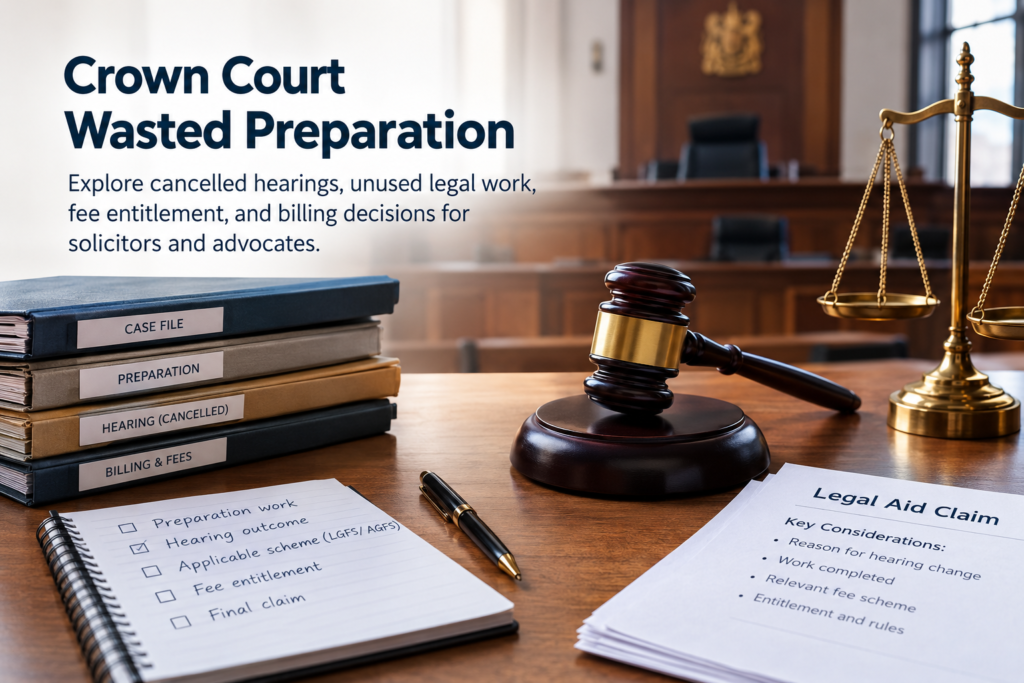
Crown Court Wasted Preparation: explore cancelled hearings, unused legal work, fee entitlement, and billing decisions for solicitors and advocates.
When the Hearing Disappears but the Work Remains
A trial has been listed for Monday. Counsel has reviewed the evidence, the solicitor has organized the defense papers, and the team has spent hours preparing for the hearing. On Friday afternoon, an unexpected development changes everything. The trial will no longer proceed as planned.
The preparation has already happened. The time has been spent. Yet the original hearing may never take place.
This is where Crown Court Wasted Preparation becomes a practical billing concern. Legal professionals must work out how the change affects the claim, whether any specific payment provision applies, and how to explain the circumstances accurately.
The answer is not always straightforward. Some preparation may remain useful if the case continues. Other work may need to be repeated. In some circumstances, the applicable fee scheme may provide a specific route for payment; in others, the work may already fall within the relevant fee or may not qualify for an additional amount.
The important distinction is between work that has been undertaken and work for which the applicable rules permit payment.
Three Situations That Can Change the Billing Decision
Not every cancelled hearing creates the same financial problem. Consider three realistic examples.
Situation One: The Trial Is Adjourned at Short Notice
A solicitor has completed substantial preparation for a trial. The defense team has reviewed disclosure, taken instructions, prepared case papers, and discussed the evidence with counsel. The court then adjourns the trial because a witness is unavailable.
The first task is to establish exactly what happened. The billing team should identify the reason for the adjournment, the procedural stage reached, and the fee provisions applicable to the case.
It should also consider which preparation remains relevant to the rescheduled trial. The original work does not become automatically payable as a separate fee simply because the hearing was postponed.
Situation Two: The Case Changes Before Trial
An advocate prepares for a contested trial, but the defendant subsequently changes their plea before the hearing begins.
The billing implications may differ from those of an adjournment. The final procedural outcome and the applicable scheme rules become particularly important.
The advocate’s team should check the relevant fee category, hearing circumstances, and provisions governing the outcome. It should not assume that the original trial preparation creates an automatic entitlement to a full trial fee or an additional preparation payment.
Situation Three: A Hearing Is Vacated Before the Listed Date
A court removes a hearing from its list before the scheduled date. The legal team has already completed some preparation, but the case may continue on a different timetable.
Here, the timing of the notification matters when reconstructing the events. The file should distinguish work completed before the hearing was vacated from work undertaken afterwards.
The billing team can then assess the circumstances under the relevant rules and identify whether further evidence or clarification is required.
These examples illustrate why the hearing outcome alone is not enough. The reason for the change, the work completed, the procedural history, and the applicable remuneration arrangements all need to be considered.
The Financial Question: Is the Work Payable?
When preparation becomes unnecessary, legal teams may feel that the time spent should be recoverable. Commercially, that concern is understandable. However, Crown Court legal aid billing follows the applicable remuneration rules rather than a simple calculation of hours worked.
A useful starting point is to separate three questions.
First, what work was actually completed? Identify the preparation undertaken, who performed it, and when it occurred. Avoid vague descriptions that make it difficult to understand the work involved.
Second, what changed? Establish whether the hearing was adjourned, vacated, replaced by another hearing, or made unnecessary by a change in the case.
Third, what do the applicable rules allow? Check the relevant LGFS or AGFS provisions and any specific requirements for the circumstances. Do not add a separate amount unless there is a valid basis for doing so.
This approach prevents a common misunderstanding: evidence that work took place is not necessarily evidence that a particular additional fee is recoverable.
LGFS and AGFS: Why the Correct Scheme Matters
The Litigators‘ Graduated Fee Scheme (LGFS) and Advocates’ Graduated Fee Scheme (AGFS) address different aspects of criminal legal aid remuneration. Their provisions should be checked separately.
For solicitors, the relevant question may concern the treatment of the litigator’s fee following an adjournment, a change in plea, or another development in the proceedings. The team should verify the case outcome and applicable fee provisions before finalizing the claim.
For advocates, the review may focus on the hearing category, the stage reached, and the circumstances in which the listed hearing did not proceed. The advocate’s billing team should confirm how the relevant AGFS provisions apply rather than rely on assumptions drawn from another case.
Neither scheme should be treated as a general promise that unused preparation will receive a separate payment. The precise circumstances and the rules in force for the relevant claim determine the appropriate treatment.
The Case File Tells the Story
Imagine that a billing assessor reviews a claim and finds a substantial amount of preparation recorded against a trial that never took place.
The assessor needs to understand the sequence of events. Why was the trial listed? What preparation did the legal team undertake? When did the hearing change? What happened to the case afterwards? How has the claim been calculated?
A file that answers these questions clearly is easier to review than one containing scattered notes and unexplained entries.
The strongest record is not necessarily the longest. It is the one that accurately connects the work performed with the events in the case.
A practical record might include the following:
| Record | What it helps establish |
|---|---|
| Court notice or order | The hearing date and the change to the listing |
| Case chronology | The sequence of procedural events |
| Attendance notes | Relevant work and communications |
| Time records, where applicable | When preparation occurred and who performed it |
| Correspondence | The circumstances surrounding the change |
| Claim calculation | How the submitted fee relates to the applicable rules |
The exact documents required depend on the claim and the relevant guidance. Teams should retain and submit the material required by the applicable provisions, rather than assume that every document in the table is mandatory in every case.
What Happens When Preparation Must Be Repeated?
A postponed trial can create another complication. The original preparation may remain useful, but developments during the delay may require further work.
For example, additional disclosure may arrive, witness evidence may change, or counsel may need to reconsider a legal argument. The legal team could therefore face both earlier preparation and new work for the rescheduled hearing.
The billing review should distinguish between these activities. It should identify what was completed originally, what had to be revisited, and whether the applicable scheme provides for the relevant work.
Repeated work should not automatically be entered as a separate recoverable fee. The team must check the applicable rules and avoid duplication where the same work is already reflected in another part of the claim.
This distinction also helps firms understand the operational impact of repeated preparation, even where the remuneration rules do not allow every additional task to be billed separately.
Why Claims Become Difficult to Explain
Problems often begin when the case file and the claim tell different stories.
A chronology may show that a trial was vacated, while the claim appears to treat it as having proceeded. Time entries may refer to preparation without identifying the hearing concerned. A later hearing may appear in the records without any explanation of how it relates to the original listing.
These inconsistencies do not automatically determine the outcome of a claim, but they can make assessment more difficult.
Another problem arises when staff rely on the treatment used in a previous case. Two cases may look similar but have different procedural histories or fall under different provisions. A past payment does not, by itself, prove that the same treatment is correct in a new claim.
A better approach is to document the facts first and determine the fee treatment afterwards. This keeps the billing decision tied to the actual case rather than to assumptions or habits.
A Better Way to Manage Hearing Changes
Instead of waiting until the final claim is prepared, firms can record significant hearing changes as they happen.
When the court changes a listing, the responsible team member can update the case chronology and preserve the relevant notification. The fee earner can record the work already completed and identify any further preparation required. The billing team can then review the applicable rules when sufficient information is available.
This creates a clearer record and reduces the need to reconstruct events months later.
It also makes handovers easier. If the person who prepared the case is unavailable when the claim is reviewed, another member of the team should still be able to understand the history from the file.
For unusual cases, a short internal note explaining the selected billing treatment can be valuable. It should identify the relevant circumstances and rules without suggesting that an uncertain entitlement is guaranteed.
What Legal Teams Should Take Away
A cancelled or postponed hearing can leave a significant amount of work behind, but the billing outcome depends on more than the time invested.
For solicitors and advocates, the most reliable approach is to establish the actual hearing outcome, document the preparation undertaken, and check the relevant fee scheme before submitting the claim. Where the rules are unclear, the issue should be investigated rather than resolved through guesswork.
Crown Court Wasted Preparation is therefore as much a question of accurate case records and correct fee treatment as it is a question of unused legal work.
The goal is not to claim every hour simply because it was spent. It is to ensure that the claim reflects the work, the procedural history, and the remuneration rules that genuinely apply.