Understand the Crown Court Billing Journey from case preparation and evidence review through claim preparation, assessment, and final payment.
A Crown Court case creates a large amount of legal work long before anyone starts thinking seriously about the final bill.
A solicitor may begin with a new client and a limited amount of information. Over time, the file can grow with prosecution papers, client conferences, hearings, correspondence, preparation, evidence, and changing instructions.
When the legal proceedings eventually reach a conclusion, another question comes forward:
How does all of that work become a Crown Court legal aid claim?
The answer is not simply a matter of adding up everything that happened.
During the billing stage, the legal team reviews the completed case carefully. They confirm the outcome and check the relevant records. The team also considers the appropriate fee arrangements and gathers any supporting information required for the claim. Finally, they prepare the claim for submission.
That is the real Crown Court Billing Journey.
It begins with the case itself and continues until the team has assessed the claim and understood the payment position.
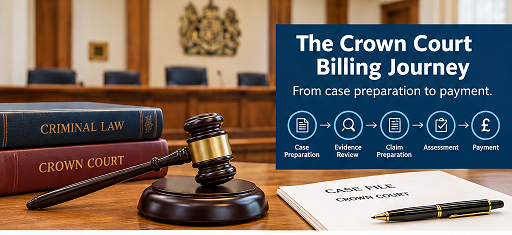
Understanding the Crown Court Billing Journey
The Crown Court Billing Journey connects the work carried out during a case with the legal aid claim prepared after the proceedings conclude. This journey helps legal teams see how case records, evidence, hearings, outcomes, billing information, assessment, and payment fit together.
A claim becomes easier to prepare when the team records relevant information throughout the case. Instead of reconstructing the entire matter at the end, the billing team can work from a clear history of what happened and check the information against the applicable billing requirements.
A Case Rarely Stays the Same From Beginning to End
Imagine a new Crown Court matter arriving at a legal practice.
At the beginning, it may appear relatively straightforward.
The client has representation. Initial papers are available. A hearing date has been set. The legal team starts preparing.
Then things change.
More evidence arrives.
The client provides further instructions.
Another hearing becomes necessary.
The issues become more complicated.
The amount of preparation increases.
This pattern occurs in many legal cases. From a billing perspective, the final file may look very different from the file that existed at the beginning.
For that reason, the billing team needs to review the complete history rather than rely on the first information recorded about the case.
The Preparation Stage Creates the Foundation
Good billing often begins with good case administration.
During the life of a Crown Court matter, the legal team creates records that later become important when they prepare the claim.
These records may include hearing information, evidence details, case correspondence, attendance records, instructions, and other documents connected with the proceedings.
The purpose is not to create paperwork simply for the sake of paperwork.
Accurate records help explain what happened.
When the case reaches the billing stage, those records provide the background needed to understand the claim.
A well-organised file usually makes review easier than a file with important information scattered across emails, notes, folders, and separate systems.

When the Evidence Starts Growing
Evidence can change the character of a case.
A small initial file can become much larger as additional prosecution material arrives.
The legal team may then spend more time reviewing the material and advising the client.
The advocate may also need to prepare differently for an upcoming hearing.
From a billing perspective, the team should not ignore the growth of the case.
Instead, the legal team should record and retain relevant information as the matter develops.
This approach becomes particularly important when evidence-related information forms part of the fee calculation under the applicable scheme.
The Client’s Instructions Can Change the Picture
Legal cases do not depend entirely on documents.
The client’s instructions can also develop.
A client may raise new matters during a conference. New information may require further advice. A legal strategy may also need reconsideration.
Each development contributes to the history of the case.
The billing team does not need to turn every conversation into a separate billing entry. Instead, the team needs to identify which information matters under the applicable legal aid billing rules.
That distinction matters.
The objective is an accurate claim, not simply a long list of everything that happened.
A Hearing Can Change the Direction of a File
A court hearing can sometimes be straightforward.
On another occasion, an unexpected issue may arise.
The hearing may take longer than anticipated. Another date may become necessary. Further preparation may follow.
Once the hearing ends, the file continues.
The legal team records what happened and prepares for the next stage.
Months later, the billing team can use those records when reviewing the completed file.
Recording information when events occur makes the billing review easier than trying to reconstruct the case from memory later.
The Case Reaches Its Turning Point
Eventually, the case reaches a significant conclusion.
Perhaps the client entered a guilty plea.
Perhaps the matter proceeded to trial.
Perhaps the case concluded in another way recognised by the relevant fee scheme.
Whatever the outcome, it becomes an important part of the billing picture.
The billing team now has something that was not available at the beginning:
the final outcome of the case.
That information helps the team determine how to consider the completed matter under the applicable billing arrangements.
Now the Billing Team Sees the File Differently
The solicitor may have focused on legal strategy.
The advocate may have focused on courtroom preparation.
The client may simply have waited for the case to end.
The billing professional approaches the same file from another direction.
The questions become practical:
- What type of matter was this?
- How did it conclude?
- What information supports the claim?
- Which fee arrangements apply?
- Are the relevant records complete?
- Are there unusual aspects that need attention?
- Is supporting documentation available?
The file has now moved from active legal work toward financial administration.
The Billing Review Begins
This is where a detailed file review becomes valuable.
The reviewer can work through the case history and compare the information available in different records.
The team can check dates and confirm the outcome.
It can review evidence information and locate supporting documents.
The reviewer can also investigate potential inconsistencies.
The purpose is not to make the file look complicated.
The purpose is to make the claim accurate.
A short review before submission can sometimes prevent much more work later.
A Small Error Can Become a Larger Problem
Consider a simple situation.
One internal record gives a hearing date.
Another document appears to show a different date.
If nobody notices the difference, incorrect information could potentially enter the billing process.
However, if the team identifies the discrepancy during its review, it can investigate the issue.
The reviewer can locate the correct record and update the file where appropriate.
The team can then prepare the claim using verified information rather than an assumption.
This is one of the less visible but important parts of Crown Court billing.
Understanding the Difference Between Legal Work and Recoverable Fees
A legal professional may perform many different tasks during a case.
However, not every task automatically becomes a separately payable item.
Crown Court legal aid billing works within specific fee schemes and rules.
For that reason, the billing professional has to understand the difference between the work that occurred and the remuneration that can properly be claimed.
Simply exporting every activity from a case-management system is not enough.
The billing team needs to review the information in the context of the applicable billing arrangements.
Where Unusual Work Appears
Some cases do not fit neatly into an ordinary pattern.
There may be unusual preparation, additional complexity, extensive evidence, or circumstances requiring closer examination.
When something unusual appears, the billing team should identify it rather than allow it to disappear into the general file.
The team should review the relevant records and consider the applicable rules.
It should also gather any required supporting information.
The key is to deal with the unusual element using evidence and the relevant billing requirements.
The Claim Starts Coming Together
After the review, the file begins to make sense from a billing perspective.
The team knows the case outcome.
It has identified the relevant information.
The reviewers have investigated outstanding questions.
The billing professional has located the supporting material.
The team can now prepare the claim using information drawn from the completed case.
This marks an important transition.
The legal case may be over, but the administrative work connected with obtaining payment remains active.
Why a Final Review Matters
Before submission, another review can provide useful protection against avoidable mistakes.
The reviewer can examine the claim as a whole.
Does the information tell a consistent story?
Does the outcome match the case records?
Are the relevant details complete?
Are supporting documents available where required?
Have unusual elements received proper consideration?
Has the team prepared the claim under the appropriate billing arrangement?
A final review does not guarantee that every assessment issue will disappear.
However, it gives the firm an opportunity to identify obvious problems before the claim leaves the practice.
From the Office to the Assessment Stage
Once the team submits the claim, the focus changes again.
The claim moves into the assessment process.
The relevant authority considers the information supplied under the applicable legal aid requirements.
Depending on the circumstances, the assessor may accept the amount claimed, adjust it, or request further information.
This stage matters because submission does not necessarily mean payment.
The team still needs to monitor the claim during the assessment period.
When the Assessment Comes Back
The billing team should review an assessment result rather than simply file it away.
The team can compare the result with the original claim.
If the amount differs, the reviewer should identify the reason.
If the assessor has requested information, the relevant file material can provide the answer.
If the applicable procedures allow further action, the team can consider the appropriate next step.
A clear record of the submission and later correspondence makes this stage easier to manage.
The File May Come Back to Life
It is tempting to think that the file is finished once the court proceedings end.
In reality, billing matters can bring the file back into attention.
An assessment query may require someone to locate an old document.
A billing discrepancy may require the team to check a date.
A question about the claim may require another review of the case history.
Good record keeping therefore continues to provide value after the courtroom work has finished.
Payment Is the Visible End of the Journey
Eventually, the billing process reaches the payment stage.
The legal practice can reconcile the amount received against the assessed claim and update its financial records.
For many people involved in the case, this is the point where the billing journey becomes visible.
However, payment represents only the final part of a much longer chain of work.
The quality of the payment outcome can depend on decisions made much earlier in the case.
A Completed Claim Can Improve the Next One
One useful benefit of reviewing completed billing files is that patterns become easier to spot.
Perhaps a particular type of case regularly produces missing information.
Maybe a certain document is often difficult to locate.
The billing staff may also notice that they repeatedly ask fee earners the same question.
These observations can lead to improvements in internal procedures.
A firm might update its case checklist, change how it stores records, or introduce an earlier billing review.
The next case can then start with a better process.
The Full Crown Court Billing Journey
The journey can be viewed in a simple way:
Case preparation → evidence and instructions develop → hearings take place → the matter concludes → the completed file is reviewed → the claim is prepared → the claim is submitted → assessment takes place → payment is reconciled
But the real work happens between these stages.
Every case has its own circumstances.
Every file develops differently.
The billing team therefore needs to understand the actual history of the matter rather than treat every claim as an identical transaction.
Practical Habits That Can Make Billing Easier
A few straightforward habits can support a more organized billing process.
Keep important case information up to date rather than waiting until the end.
Record relevant dates while they are still fresh.
Keep supporting documents in an identifiable location.
Make sure changes in the case appear in the relevant records.
Do not assume that information recorded at the beginning of the matter will remain correct throughout the case.
Review unusual developments rather than overlooking them.
Most importantly, allow enough time for a proper final billing review.
The objective is not simply to submit quickly.
It is to submit accurately.
Why the Billing Journey Starts Earlier Than It Seems
The final claim may come together after the legal proceedings have finished, but the team creates its foundation much earlier.
The documents gathered during preparation matter.
The records created during hearings matter.
The evidence information matters.
The case outcome matters.
The organization of the file matters.
When the team maintains these pieces properly, the final billing stage becomes much easier to understand.
When records are missing or inconsistent, the billing team may need to spend additional time reconstructing the case.
Final Thoughts
The journey from case preparation to payment is not one single task.
It is the gradual movement of a Crown Court matter from active legal work into a completed legal aid claim.
The case begins with preparation.
The evidence and instructions develop.
Hearings take place.
The matter eventually reaches an outcome.
The completed file then moves into a billing review.
The team prepares and submits the relevant claim.
Assessment follows.
Finally, the practice reconciles the payment.
For legal practices, the most useful approach is to see billing as part of the wider life of the case rather than something that suddenly appears after the courtroom work has finished.
A well-maintained file gives the billing team the information it needs.
A careful review helps identify inconsistencies.
A clear understanding of the applicable fee arrangements helps turn a complicated case history into a properly prepared claim.
That is the real Crown Court Billing Journey — from the first stages of case preparation through to the point where the final payment is accounted for.