How Does Crown Court Billing Work? A Step-by-Step Guide for Legal Teams
Introduction
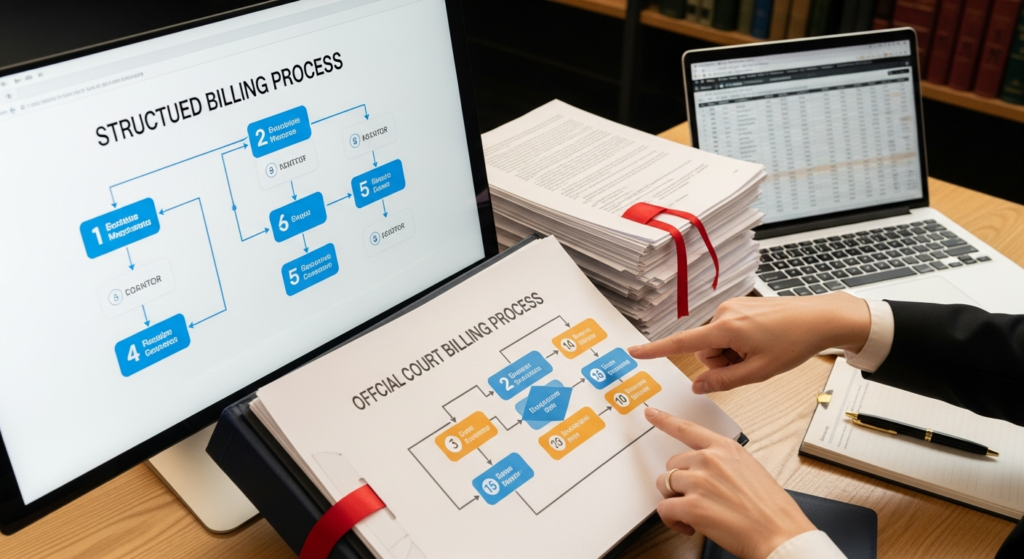
How does Crown Court billing work? This is one of the first questions every criminal defence solicitor needs to answer. The process is structured, rule-based, and directly linked to how much the firm recovers for its legal aid work.
Crown Court billing is not a single action. It is a sequence of steps that begins at the start of a case and ends when the Legal Aid Agency processes the payment. Every step matters. Errors at any stage delay or reduce the payment.
This guide walks through the full Crown Court billing process — from the moment a case concludes to the point the firm receives payment. It also covers the key rules, common pain points, and practical tips for each stage.

How Does Crown Court Billing Work? The Overview
What is Crown Court Billing?
Crown Court billing is the formal process of claiming fees for criminal defence work conducted in the Crown Court. Solicitors and barristers submit separate claims to the Legal Aid Agency. The LAA reviews each claim against the applicable funding scheme and pays the approved amount.
Most Crown Court cases run under the Graduated Fee Scheme. Some complex or very high-cost cases use different arrangements. The scheme determines how the LAA calculates the fee.
Understanding the process from start to finish helps billing teams prepare accurate claims and avoid the errors that lead to queries, reductions, or rejections.
Step 1: Record Work Throughout the Case
Crown Court billing starts long before the case concludes. Good records are the foundation of every accurate claim. Teams that record work as it happens produce bills faster and with fewer errors than teams that reconstruct records at the end.
What to Record
Record every hearing with the date, court, duration, and outcome. Log all client conferences — time spent, location, and purpose. Track preparation time with a brief note of what the work involved. Note every disbursement as it occurs, with the supplier, amount, and purpose.
Why This Matters
The LAA can query any item it cannot verify. Contemporaneous records are far harder to challenge than reconstructed ones. Strong records also speed up the billing process once the case concludes.
Step 2: Confirm the Case Conclusion
The billing process becomes active once the case concludes. The outcome affects which fees apply and how the claim is structured.
Types of Case Conclusion
Crown Court cases conclude in several ways. A guilty plea, a cracked trial, a full trial, or an acquittal all carry different billing implications. The stage at which a plea is entered — and whether the case cracked — determines which rules apply under the Graduated Fee Scheme.
Confirm the exact conclusion type from the court record. Do not rely on memory or verbal updates. The billing team needs the precise outcome before preparing the claim.
Step 3: Identify the Correct Funding Scheme
Not every Crown Court case uses the same billing scheme. Most legal aid cases fall under the Graduated Fee Scheme. Some cases qualify as Very High Cost Cases and use a different contractual arrangement.
The Graduated Fee Scheme
The Graduated Fee Scheme calculates fees using several factors. These include the offence category, the number of pages of prosecution evidence, the number of trial days, the case outcome, and the stage at which the case concluded.
Each factor feeds into a formula the LAA uses to arrive at the payable fee. Getting any factor wrong changes the result. Check the scheme rules before preparing the bill — not after.
Step 4: Select the Correct Offence Category
Offence category is one of the most important inputs in any Crown Court billing claim. The LAA assigns each type of offence to a category. Each category carries a different base fee.
Select the category that matches the charge on the indictment. Use the LAA’s current offence table. Never estimate or group similar offences together — even offences that appear related can fall into different categories with different fee levels.
Check the LAA guidance each time. Fee tables and offence categories do change.
Step 5: Apply the Correct Fee Codes
Fee codes identify the type of work being claimed. Crown Court billing uses a specific code for each type of hearing, preparation activity, and disbursement. Using the wrong code produces an incorrect payment.
Common Fee Code Mistakes
Many billing teams apply codes from memory. This works until the LAA updates the fee schedule. Teams that do not check current codes regularly find their claims rejected or reduced without understanding why.
Keep a current copy of the fee schedule accessible. Cross-check every code against it before finalizing the claim. Train billing staff on code changes whenever the LAA publishes updates.
Step 6: Calculate the Fee
Once the scheme, offence category, and fee codes are confirmed, the team calculates the total fee. The calculation covers several elements.
What the Fee Calculation Covers
The basic fee depends on the scheme and offence category. Additional elements include daily attendance fees for trials, refresher fees for long hearings, pages of prosecution evidence, and any applicable uplifts. Uplifts apply in specific circumstances — for example, cases with high evidence volumes or multiple defendants.
Many firms undercharge because they miss uplifts. Check the uplift rules for every case before finalising the calculation.
Step 7: Compile Supporting Documents
Crown Court billing requires supporting documents alongside the claim form. The LAA needs evidence to verify what is being claimed. Missing or incomplete documents are among the most common reasons claims are queried.
Documents to Include
A standard Crown Court billing submission includes the representation order, the indictment, the court result, counsel’s instructions and brief fee, disbursement invoices, and any prior authority approvals. Some claims require additional documents depending on the case type or items being claimed.
Use a document checklist for every case type. Attach clean, readable copies of everything. Check that all documents are present before submission — not during a query.
Step 8: Submit the Claim
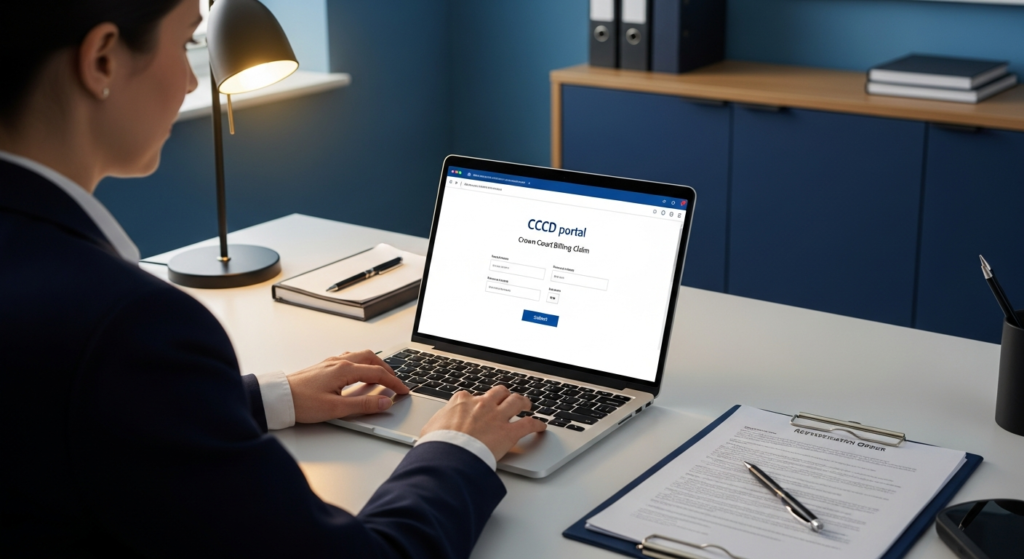
Claims go to the Legal Aid Agency via the online Claim for Crown Court Defence system, known as CCCD. The system guides the user through the claim structure. It also performs basic validation checks that catch some common errors before submission.
Submission Deadlines
Crown Court billing has strict submission deadlines. Missing a deadline can mean losing the right to claim entirely. Set internal deadlines well ahead of the LAA cut-off. Do not wait for outstanding documents before starting the preparation — chase them early.
Submit the claim as soon as it is ready. Completed cases sitting unbilled represent delayed income and unnecessary risk.
Step 9: Respond to LAA Queries
The LAA reviews every claim it receives. Some claims pass through without queries. Others attract requests for additional information, clarification, or supporting documents.
How to Handle Queries
Respond to queries promptly and completely. Provide exactly what the LAA requests — no more, no less. Keep a record of every query and response. Repeated queries on the same issues point to a process problem worth fixing.
Monitor outstanding queries actively. Unanswered queries delay payment and can lead to the claim being decided on incomplete information.
Step 10: Receive and Review Payment
The LAA processes approved claims and issues payment. Review every payment against the submitted claim. Check that the amount matches what was claimed — or understand why it differs.
What to Do If the Payment Is Wrong
Crown Court billing payments can be lower than the submitted amount if the LAA has applied a reduction. The payment advice will show the reason. Firms that disagree with a reduction can request a redetermination. There are strict time limits for doing so.
Track payments against claims as a routine step. Do not assume every payment is correct.
Crown Court Billing Process: Quick Reference
| Step | Action |
|---|---|
| 1 | Record work throughout the case |
| 2 | Confirm the case conclusion and outcome |
| 3 | Identify the correct funding scheme |
| 4 | Select the correct offence category |
| 5 | Apply the correct fee codes |
| 6 | Calculate the total fee including uplifts |
| 7 | Compile all supporting documents |
| 8 | Submit the claim via CCCD before the deadline |
| 9 | Respond to any LAA queries promptly |
| 10 | Review the payment and act on any reductions |
Conclusion
How does Crown Court billing work? It works step by step — from recording work at the start of a case to reviewing the payment at the end. Every step in the process affects how much the firm recovers and how quickly it gets paid.
Firms that treat billing as a sequence of disciplined steps — not a single end-of-case task — make fewer errors, receive fewer queries, and recover more of what they earn. Build the process into your practice from day one, and billing becomes faster, cleaner, and more reliable.
Frequently Asked Questions: How Does Crown Court Billing Work?
How does Crown Court billing work for solicitors? Solicitors record all work during the case, confirm the outcome, select the correct scheme and fee codes, compile supporting documents, and submit the claim to the LAA via the CCCD system. The LAA reviews the claim and pays the approved amount.
How long does Crown Court billing take to process? Processing time depends on the scheme, the claim’s complexity, and whether the LAA raises any queries. Clean, complete claims submitted on time are processed more quickly than those requiring follow-up.
What is CCCD in Crown Court billing? CCCD stands for Claim for Crown Court Defence. It is the LAA’s online portal for submitting Crown Court billing claims. All solicitor claims for legal aid Crown Court work go through this system.
What happens if a Crown Court billing claim is rejected? The LAA will notify the firm with the reason for rejection. In most cases, firms can correct and resubmit within the allowed timeframe. Persistent rejections usually point to a recurring process error worth investigating.
How are Crown Court billing fees calculated? Under the Graduated Fee Scheme, fees are calculated using the offence category, pages of prosecution evidence, number of trial days, case outcome, and any applicable uplifts. The LAA’s fee schedule sets the figures for each element.
Can Crown Court billing claims be appealed? Yes. Firms that disagree with a reduced or rejected payment can request a redetermination from the LAA. There are strict deadlines for doing so. If the redetermination outcome is still unsatisfactory, further appeal routes exist.