Crown Court Billing Mistakes to Avoid: A Practical Guide for Legal Teams
Introduction
Crown Court billing mistakes cost firms money, delay payments, and create unnecessary workload. Every error that reaches the Legal Aid Agency means a query, a rejection, or a reduced payment. Most of these mistakes are preventable.
This guide covers the most common Crown Court billing mistakes, explains why they happen, and gives practical steps to stop them. Whether you prepare bills yourself or manage a billing team, these fixes will improve your recovery rate.

What is Crown Court Billing Mistakes? Why They Matter
What is Crown Court Billing Mistakes?
Crown Court billing mistakes are errors in the preparation or submission of legal aid claims that result in underpayment, rejection, or delay. They range from simple data entry errors to deeper misunderstandings of LAA fee rules.
Billing errors affect the firm in three direct ways. First, rejected claims slow down cash flow. Second, reduced payments mean the firm recovers less than it earned. Third, repeated errors take staff time to investigate and correct.
Teams that understand where mistakes happen can build processes to catch them early.
The Most Common Crown Court Billing Mistakes
Mistake 1: Using the Wrong Fee Code
Crown Court billing relies on a precise system of fee codes. Each code corresponds to a specific type of work, case type, or hearing. Using the wrong code — even by one digit — leads to an incorrect payment or an outright rejection.
Many billing teams apply codes from memory. This works until the LAA updates the guidance. Check the current fee schedule before preparing every claim. Do not rely on last year’s codes.
Mistake 2: Selecting the Wrong Offence Category
The offence category directly affects the fee payable under the Graduated Fee Scheme. Picking the wrong category — even when it seems similar to the correct one — changes the calculation. Some categories pay significantly more or less than others.
Always confirm the offence category against the LAA’s current offence table. Match it exactly to the charge on the indictment. Never estimate or group similar offences together.
Mistake 3: Inaccurate Time Recording
Crown Court billing depends on accurate time records. Missing attendance notes, estimated durations, and vague entries all weaken the claim. The LAA can query or reduce fees when records do not support the time claimed.
Record hearing times, conference times, and preparation time as they happen. Do not reconstruct them at the end of the case. Contemporaneous records are harder to challenge and easier to bill from.
Mistake 4: Missing or Unreadable Supporting Documents
Every Crown Court billing claim needs supporting documents. Indictments, representation orders, counsel instructions, and disbursement invoices must all be present and legible. Missing documents are one of the most common reasons the LAA raises a query.
Build a document checklist for every case type. Run through it before submission. Attach clean, complete copies — not blurred scans or incomplete printouts.
Mistake 5: Late Submission
Crown Court billing has strict time limits. Missing a deadline can mean losing the claim entirely. Some firms delay submission while waiting for final documents or barrister fee notes. This is an avoidable risk.
Set internal submission deadlines well ahead of the LAA deadline. Chase outstanding documents early. Never let a completed case sit unbilled for longer than necessary.
Mistake 6: Claiming Unapproved Disbursements
Not every expense qualifies as a disbursement under the legal aid rules. Claiming items the LAA does not approve — or claiming without prior authority where it is required — leads to automatic reductions.
Check the disbursements guidance before including any item. Where prior authority is needed, apply for it before incurring the cost. Keep the approval on file and attach it to the bill.
Mistake 7: Errors in Cracked Trial Billing
Cracked trials have their own billing rules. The stage at which the crack occurs determines the fee. Billing a cracked trial as a full trial — or billing the wrong cracking stage — produces an incorrect claim.
Confirm the exact cracking stage from the case notes and court record. Match it precisely to the LAA’s cracked trial definitions. Train billing staff specifically on this area, as it causes frequent errors.
Mistake 8: Not Claiming All Available Uplifts
Crown Court billing allows uplifts in specific circumstances — for example, cases with high page counts or multiple defendants. Many firms miss these uplifts simply because staff are unaware they apply.
Review the uplift rules for every case before finalizing the bill. Check page counts, defendant numbers, and any other qualifying factors. Unclaimed uplifts represent direct lost income.
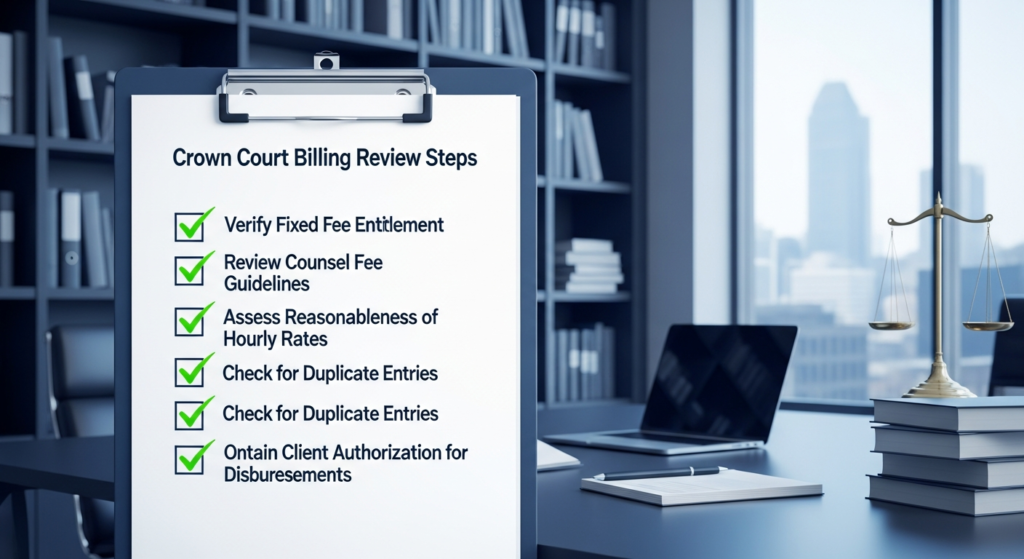
How to Prevent Crown Court Billing Mistakes
Build a Pre-Submission Checklist
A checklist catches errors before they leave the office. Include fee codes, offence category, hearing dates and times, disbursements, supporting documents, and applicable uplifts. Run it on every claim without exception.
Review Claims Before Submission
One person preparing a claim is not enough. A second reviewer — whether a senior fee earner or billing manager — will catch errors the preparer missed. Build this review into your standard process.
Train Staff Regularly
Crown Court billing rules change. The LAA updates guidance, fee rates, and offence tables. Teams that train only once fall behind. Schedule regular training updates and circulate changes to all relevant staff as they happen.
Analyse Rejected and Queried Claims
Every rejection or query contains useful information. Track them by error type. Patterns show you where your process is weakest. Fix the root cause rather than just correcting individual claims.
Keep Records Throughout the Case
Good billing starts at the beginning of the case — not at the end. Update records after every hearing, conference, and preparation session. Cases that are well-documented from the start take far less time to bill and produce fewer errors.
Crown Court Billing Mistakes: Quick Reference
| Mistake | Why It Happens | How to Fix It |
|---|---|---|
| Wrong fee code | Outdated knowledge | Check current schedule every time |
| Wrong offence category | Estimation or grouping | Match exactly to the indictment |
| Inaccurate time recording | Reconstructed records | Record contemporaneously |
| Missing documents | No checklist | Use a pre-submission checklist |
| Late submission | Waiting for documents | Set early internal deadlines |
| Unapproved disbursements | Unclear rules | Check guidance before incurring costs |
| Cracked trial errors | Complex rules | Train specifically on cracked trials |
| Missed uplifts | Lack of awareness | Review uplift rules on every claim |
Conclusion
Crown Court billing mistakes are common, but they are not inevitable. Most stem from outdated knowledge, poor record-keeping, or skipped process steps. Fixing these does not require a complete overhaul — it requires consistent habits.
Use a checklist. Build in a review step. Train staff when rules change. Track errors and fix the patterns. Firms that apply these steps recover more, receive fewer queries, and spend less time correcting avoidable mistakes.
Frequently Asked Questions About Crown Court Billing Mistakes
What are the most common Crown Court billing mistakes? The most common mistakes are using wrong fee codes, selecting incorrect offence categories, missing supporting documents, recording time inaccurately, and submitting claims after the LAA deadline. Each of these is preventable with the right process.
How do Crown Court billing mistakes affect payment? Mistakes cause queries, reductions, or outright rejections. Each outcome delays payment and often results in the firm recovering less than it earned. Repeated errors also create extra work for billing staff.
Can a rejected Crown Court bill be resubmitted? In many cases, yes — but only within the allowed timeframe and subject to the LAA’s rules on amendments. Prevention is always faster and less costly than correction.
How can I reduce Crown Court billing mistakes in my firm? Use a pre-submission checklist, add a second-reviewer step, train staff regularly on current LAA guidance, and track the type of errors you receive. Addressing root causes reduces mistakes more effectively than fixing individual claims.